
Introduction
If you and your spouse do not agree on a divorce, you are dealing with a contested divorce process. In a contested case, one spouse files for divorce and the other spouse disagrees with the divorce itself or with important terms like maintenance, child custody, or property division. The court then steps in, hears both sides, and decides the outcome.
This guide explains the contested divorce process in India in simple, practical language. We walk through the legal grounds, the step-by-step contested divorce procedure, the documents you need, how long it usually takes, and why having the right legal team matters. By the end, you will know what to expect before you decide to go ahead. If you want to read more on related topics, you can also explore our latest articles on the Themis Law Associates blog.
What Is a Contested Divorce?
A contested divorce starts when one spouse (the petitioner) files a divorce petition in court, and the other spouse (the respondent) does not agree. The disagreement can be about:
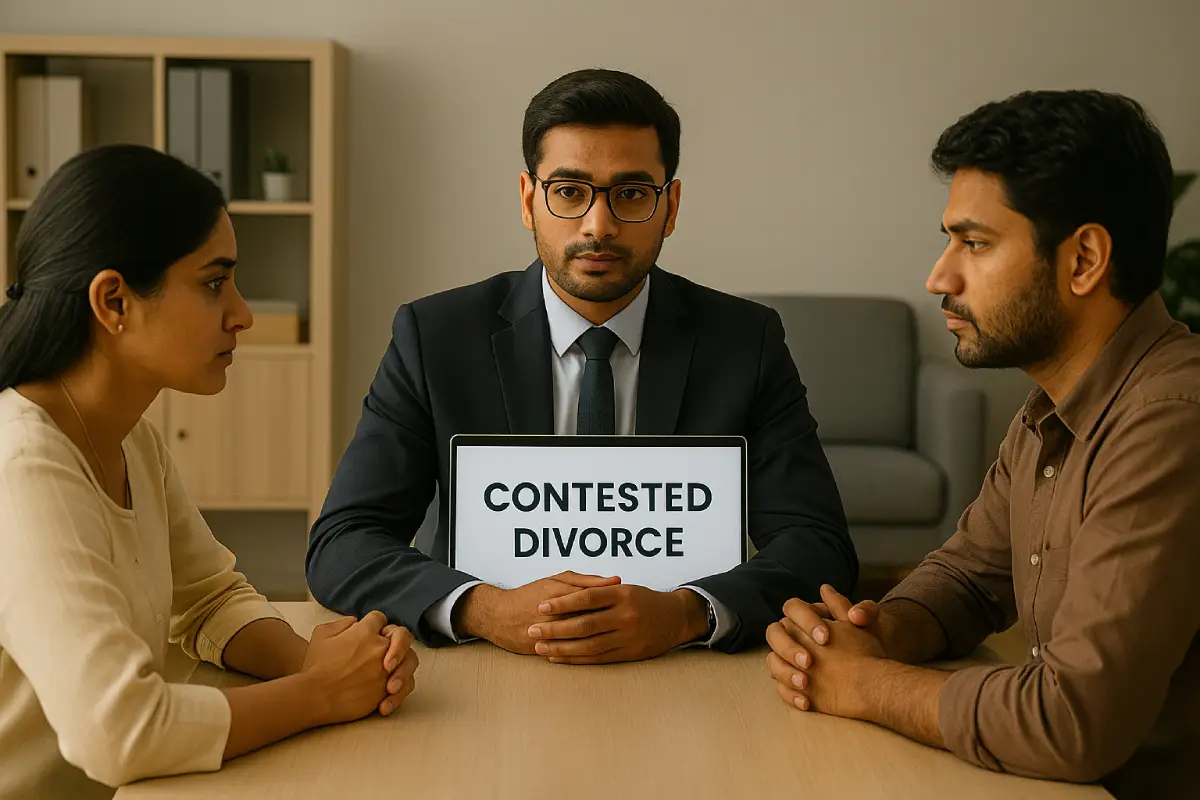
- Ending the marriage itself, or
- Terms like alimony, child custody, or property sharing.
In India, the contested divorce process is governed by personal laws, such as:
- Hindu Marriage Act, 1955 (for most Hindus, Buddhists, Jains, and Sikhs)
- Special Marriage Act, 1954 (for civil and interfaith marriages)
- Indian Divorce Act, 1869 (for Christians)
- Muslim personal law and other community‑specific laws
Where do you file the petition?
In most cases, you file the petition in the Family Court or District Court:

- Where the marriage was solemnized, or
- Where you and your spouse last lived together, or
- Where the wife is currently residing (in many situations, this option is available to her).
Your lawyer will check the correct jurisdiction before filing so that the case is not delayed on technical grounds. If you are based in Telangana, our overview of the divorce process in Hyderabad gives useful city-specific context on how local family courts function.
Contested Divorce vs Mutual Consent Divorce
People often ask whether they should choose mutual consent or contested divorce. The answer depends on how much you and your spouse can agree on.
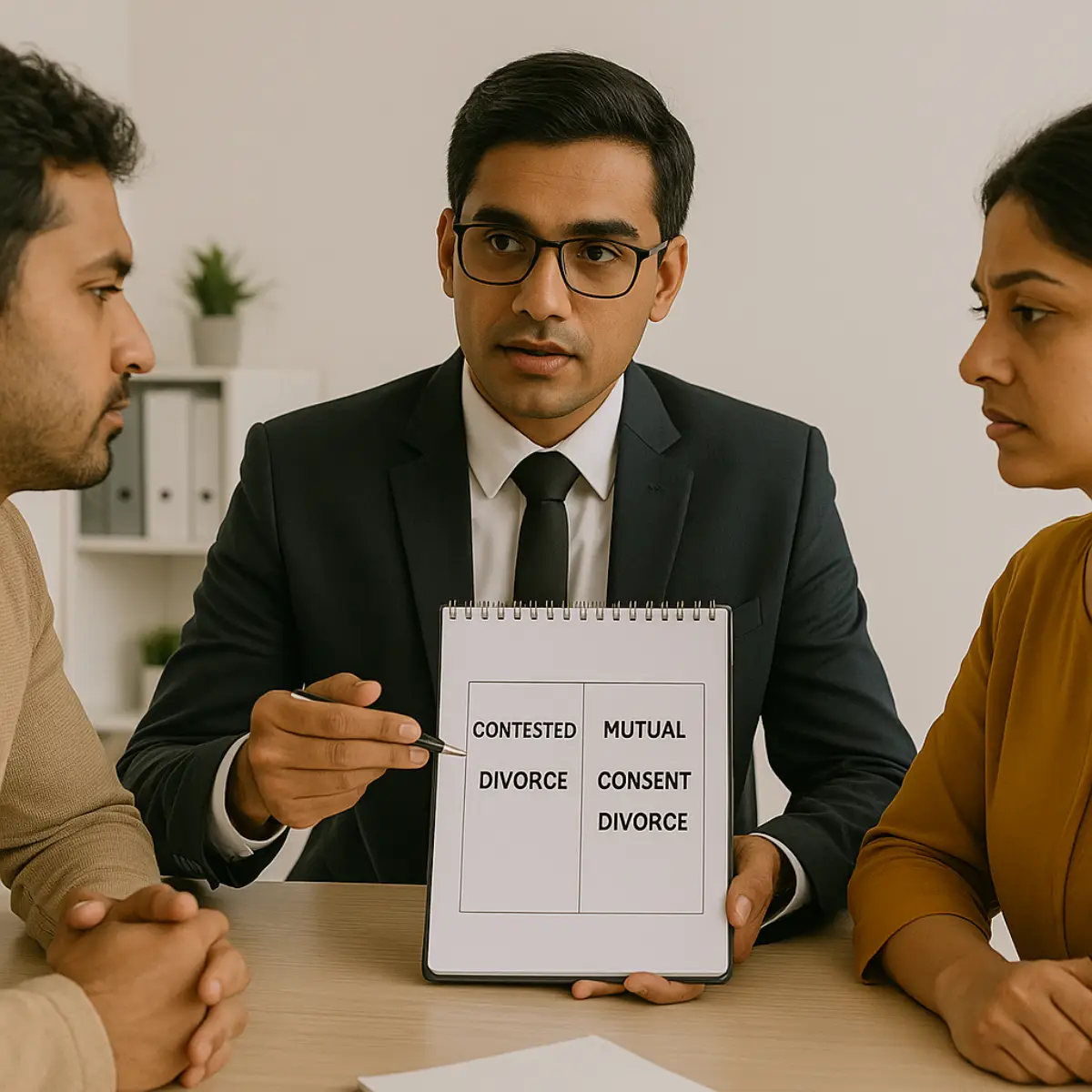
Mutual consent divorce
In a mutual consent divorce, both husband and wife agree:
- That the marriage has broken down, and
- On key terms like custody, alimony, and property.
The procedure is usually faster and simpler. There is less conflict and fewer court dates. For a detailed comparison, you can read our step-by-step mutual divorce process guide.
Contested divorce
In a contested divorce process, at least one of these things is missing:
- One spouse does not want a divorce at all, or
- One spouse disputes facts (for example, denies cruelty or adultery), or
- They cannot agree on money, children, or property.
Because the court must hear evidence, examine witnesses, and decide disputed issues, the contested divorce procedure is more complex. Cases can take three to five years or more, depending on the court’s workload and the number of disputes.
Grounds for a Contested Divorce in India
In a contested divorce, you cannot simply tell the court, “We are unhappy,” and expect a decree. The petitioner must prove at least one legally recognized ground for divorce. These grounds vary slightly between laws, but common ones include: For example, Section 13 of the Hindu Marriage Act, 1955 lists adultery, cruelty, desertion, conversion, mental disorder, communicable venereal disease, renunciation of the world, and presumption of death as recognized grounds for divorce.
1. Cruelty
Cruelty is one of the most frequently used grounds in the contested divorce process in India. It can be:
- Physical cruelty – hitting, causing injuries, or violent behaviour.
- Mental cruelty – constant insults, threats, humiliation, false criminal complaints, or behaviour that makes it impossible to live together.
Courts now recognize that long periods of forced separation, repeated threats of suicide, or continuous verbal abuse can also amount to mental cruelty.
2. Adultery
Adultery means voluntary sexual intercourse with a person who is not your spouse. This is a serious allegation and must be supported by strong, clear evidence such as:
- Hotel or travel records,
- Messages and emails,
- Photographs, or
- Witness testimony.
3. Desertion
Desertion occurs when one spouse:
- Leaves the other without good reason,
- Stays away for a continuous period (commonly two years or more, depending on the law), and
- Shows a clear intention to end cohabitation.
Both physical separation and intention to desert must be shown.
4. Mental disorder or serious illness
If a spouse has a serious mental disorder or illness that makes married life extremely difficult and there is little chance of recovery, the other spouse may use this as a ground. Courts examine medical records and expert opinions carefully before granting a decree on this basis.
5. Conversion of religion
Under the Hindu Marriage Act, conversion to another religion without the consent of the other spouse is a ground for divorce. For example, if one spouse converts from Hinduism to another faith and leaves the marital home, the other spouse may file for contested divorce.
6. Communicable venereal disease
If one spouse suffers from a serious sexually transmitted disease and hides it or exposes the other spouse to serious risk, this can be a ground, depending on the circumstances and governing law.
7. Other grounds
Other recognized grounds may include:
- Impotence or failure to consummate the marriage,
- Continuous failure to provide maintenance or support,
- Imprisonment for a serious offence,
- Renunciation of the world or presumption of death.
Your lawyer will identify the most suitable grounds under the law that applies to your marriage.
Step-by-Step Contested Divorce Procedure
Although every case is unique, most contested divorce processes in India follow a similar structure.
Step 1: Filing the petition
The aggrieved spouse files a divorce petition in the appropriate Family Court. The petition:
- Mentions the legal grounds (for example, cruelty, adultery, or desertion),
- Sets out key facts and dates, and
- Attaches basic documents such as marriage proof and initial evidence.
Step 2: Summons and response
After the petition is filed, the court issues a summons to the other spouse. The respondent must:
- Appear in court, and
- File a written statement replying to the allegations.
The respondent can deny the grounds, give their own version of events, or file a counter‑claim seeking relief like custody or maintenance.
Step 3: Mediation and settlement attempts
Under the Family Courts Act 1984, Family Courts are required to try and resolve family disputes through mediation and counselling wherever possible. During this stage:
- The judge may refer the couple to a court‑annexed mediator.
- The parties explore options for settlement, including converting the case into a mutual consent divorce.
If the settlement fails, the matter returns to the trial court.
Step 4: Interim applications and temporary relief
Contested divorce cases can take years, so the court can grant interim orders, such as:
- Temporary maintenance for the financially weaker spouse,
- Interim child custody and visitation,
- Orders preventing the sale or transfer of property,
- Protection orders in cases involving domestic violence.
These orders run during the case so that basic needs and safety are not ignored.
Step 5: Framing of issues
Once pleadings are complete, the court frames issues—specific questions it must answer in the final judgment. Examples:
- “Whether the respondent treated the petitioner with cruelty?”
- “Whether the petitioner is entitled to permanent alimony, and if so, to what amount?”
These issues guide the rest of the contested divorce procedure.
Step 6: Evidence and witness examination
This is usually the longest and most technical part of the contested divorce process.
- The petitioner presents evidence first: documents, messages, medical records, financial statements, and witnesses.
- The respondent’s lawyer cross‑examines the petitioner and their witnesses.
- Then the respondent leads their own evidence and witnesses.
- The petitioner’s lawyer cross‑examines them in turn.
Courts now also consider digital evidence—WhatsApp chats, emails, call records—subject to proper proof and legal rules on electronic records.
Step 7: Final arguments
After the evidence closes, both sides make final arguments. Lawyers summarise the facts, point to key documents, and explain how the law supports their client’s case.
Step 8: Judgment and final decree
The judge studies the evidence and arguments and then pronounces judgment. If the court is satisfied that the ground for divorce is proven, it issues a decree of divorce. The decree also covers:
- Custody and visitation rights,
- Maintenance and alimony,
- Division of assets and liabilities, where claimed.
Step 9: Appeal
If either party feels the judgment is unfair or legally incorrect, they may file an appeal in a higher court, usually within 30 days (or as per the limitation period prescribed). Appeals add more time and cost, but they offer another chance to correct serious errors.
Key Disputes in a Contested Divorce
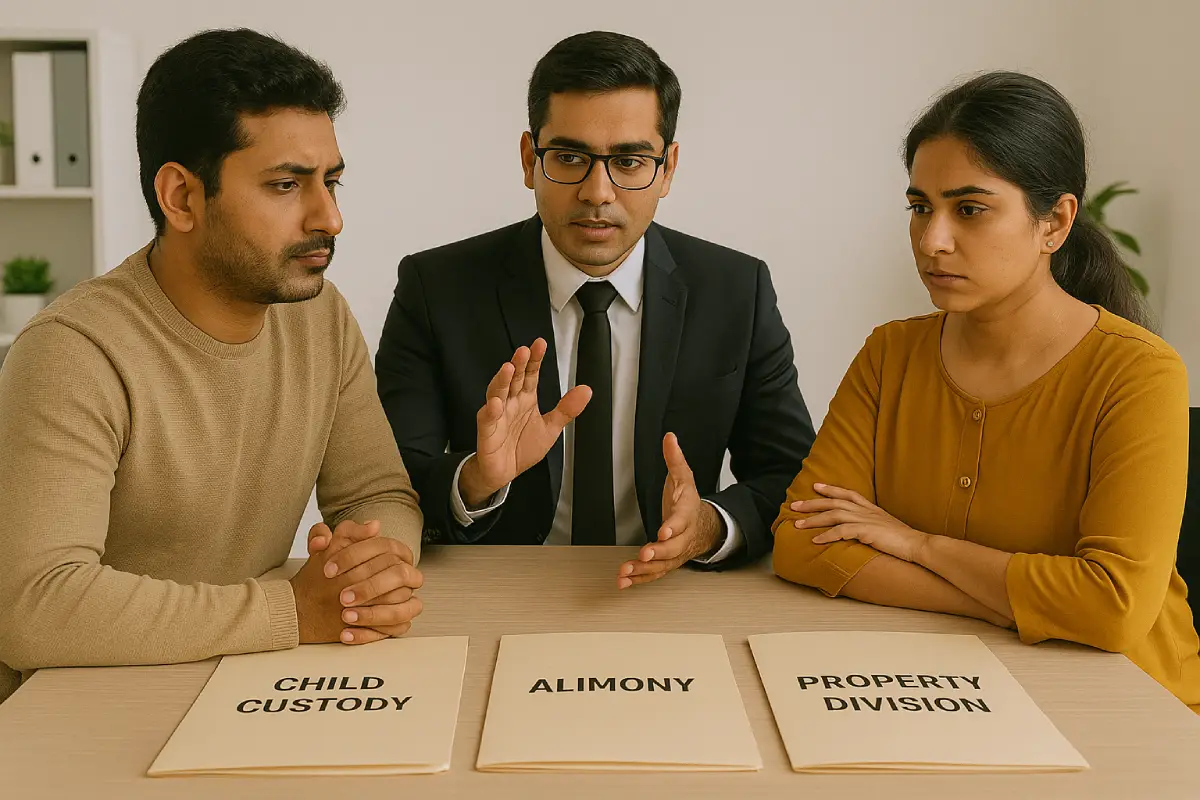
While the law focuses on grounds like cruelty or adultery, day‑to‑day disputes in a contested divorce process in India usually centre around three areas:
1. Child custody and parenting
Courts always place the welfare of the child above parental fights. They look at:
- The child’s age and needs,
- Schooling and routine,
- Emotional bonding with each parent,
- Stability and safety of each home.
Courts may order sole custody, joint custody, or detailed visitation plans.
2. Alimony and maintenance
Maintenance can be:
- Monthly payments, or
- A one‑time lump sum.
Judges consider income, earning capacity, health, lifestyle, and responsibilities of both spouses. Full financial disclosure from both sides is essential for a fair order.
3. Property and asset division
India does not automatically split everything 50‑50. Courts look at:
- Who owns each asset on paper?
- Who contributed to its purchase,
- The needs of dependent spouses and children.
Property disputes often extend the contested divorce procedure, especially when there are multiple homes, businesses, or ancestral assets.
Essential Documents for a Contested Divorce
Having proper documents ready helps your lawyer present a strong and organized case.
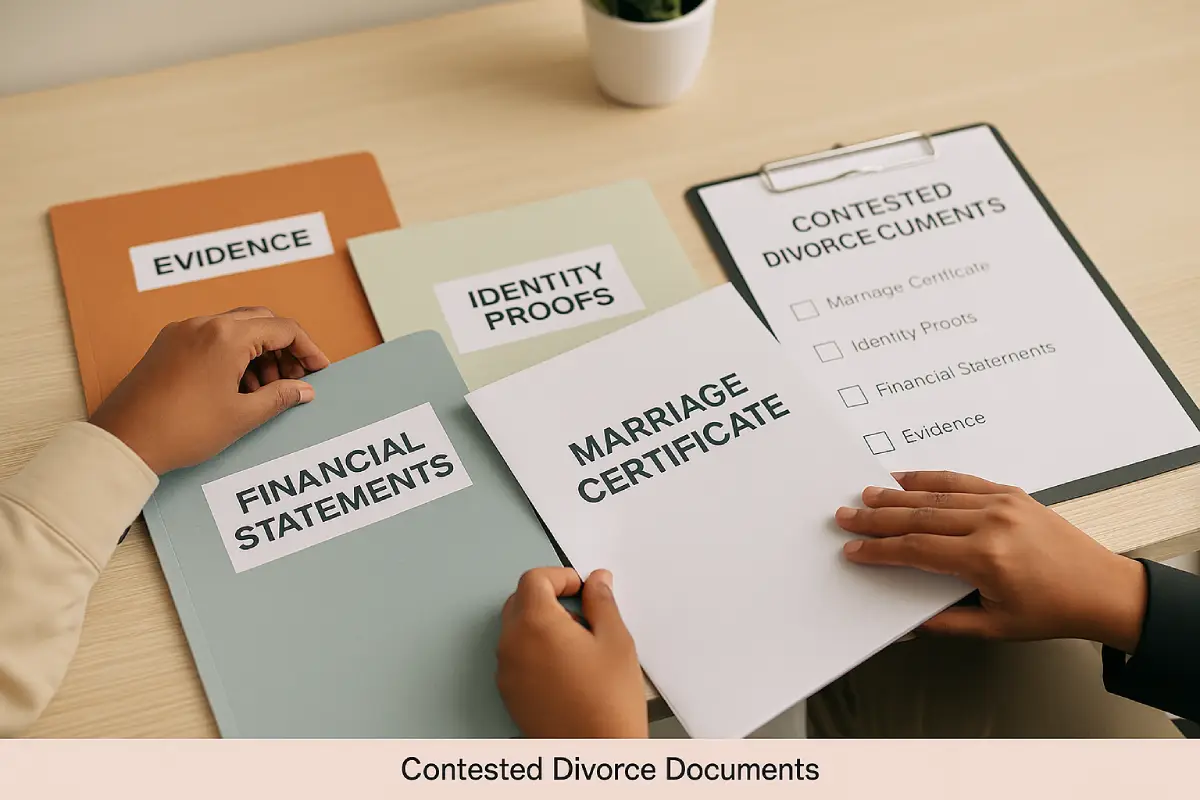
Basic documents
- Marriage certificate or other proof of marriage (wedding card, photographs)
- Identity and address proof of both spouses (Aadhaar, passport, voter ID, etc.)
- Proof of separate living, if applicable (rental agreements, correspondence)
Evidence for grounds
Depending on your case, you may need:
- Medical records showing injuries or mental illness,
- Police complaints or FIRs in cases of violence or dowry harassment,
- Evidence of adultery (travel records, chats, photos),
- Witnesses who can testify about cruelty or desertion.
Financial and property records
- Salary slips and bank statements,
- Income tax returns,
- Property papers and loan documents,
- Investment and business records.
Children and custody
- School fee receipts,
- Report cards and medical records,
- Any existing parenting plans or interim custody orders.
Your lawyer will help you shortlist what is truly necessary so that the contested divorce process remains focused.
Challenges of a Contested Divorce
A contested divorce procedure offers strong legal protection, but it also comes with real challenges:
- Emotional strain: Multiple hearings, cross‑examination, and long waiting periods can be stressful for everyone, especially children.
- Time and cost: Contested cases often run for several years and involve significant legal and court expenses.
- Public record: Allegations and evidence become part of the court record, which can feel invasive and uncomfortable.
- Uncertain outcome: Unlike a mutual consent divorce, the final decision lies entirely with the judge.
At the same time, the contested route may be necessary when:
- One spouse is abusive or refuses to cooperate,
- There is a serious dispute over children or finances,
- The other spouse uses delay tactics or will not give consent for a mutual divorce.
FAQs on Contested Divorce in India
What happens in contested divorce in India?
In a contested divorce, one spouse files a petition and the other contests it. The court then:
Sends summons to the respondent,
Tries mediation first,
Hears evidence from both sides,
Decides issues like grounds for divorce, custody, and alimony,
Finally passes a divorce decree is passed if the legal grounds are proven.
How long does a contested divorce take in India?
There is no fixed timeline, but contested divorce can take three to five years or more. The duration depends on:
The number of disputes,
How busy the court is,
How many witnesses and documents must be examined?
Whether any appeals are filed.
What is the evidence for contested divorce?
Evidence in a contested divorce process in India can include:
Documents (chats, emails, photos, medical records),
Police complaints and charge sheets,
Witness statements from family, friends, neighbours, or colleagues,
Financial records,
Expert reports (for example, doctors or counsellors).
The court looks at the overall picture, not just one document.
How difficult is a contested divorce?
A contested divorce is usually more difficult than a mutual consent divorce because:
You must prove specific grounds like cruelty or desertion,
You face cross‑examination and tight court schedules,
The emotional and financial cost can be high.
However, with proper legal advice, clear documentation, and realistic expectations, you can navigate the process in a structured way.
Conclusion: Do You Need to Start a Contested Divorce?
The contested divorce process is designed to protect legal rights when a marriage has broken down, but one spouse will not cooperate, or the disputes are too serious for a simple settlement. It is tough, but it can also bring a clear, enforceable outcome on issues like children, money, and property.
If you feel trapped in a harmful marriage or your spouse refuses to agree to fair terms, it may be time to understand your options under the contested divorce procedure. You do not have to face the system alone.
Themis Law Associates and our team of divorce lawyers in Hyderabad help you:
- Assess whether you should choose mutual consent or contested divorce.
- Identify the strongest legal grounds in your situation,
- Collect and present evidence in a professional manner,
- Protect your interests in custody, maintenance, and property.
If court battles, delays, and legal paperwork worry you, that is completely normal. Our role is to shoulder that burden so you can focus on rebuilding your life.
Reach out to Themis Law Associates today for a confidential consultation and clear guidance on the next steps that make sense for you.